In this article
Executive Summary
SCRUM is the most used agile framework in today’s world to organize or build a project. Even though SCRUM is a great framework for building a project, it has its own challenges, such as lost communication, unrefined or incorrectly defined tasks, bugs of unknown origin, unknown responsibility areas, and so on. Most of the time, these struggles are human-based, whether it’s an honest mistake or an intentional act of negligence. Still, the main question is not the source but how to find the source. Finding a way to go to the origin of the struggle is not that easy when the SCRUM team is being strafed by loss of communication, unrefined tasks, etc. While gamification is an obvious choice for improving adaptation and resolving SCRUM struggles, finding the right way to gamify the SCRUM framework is not easy.
The paper will explain one of the most utilizable methods of gamification in order to enhance teams’ and individuals’ capacities in the SCRUM methodology: the role-playing game (RPG) or FATE system. Since the 1950s, RPG has been a well-known method of playing games face-to-face. These games are bound to a world-building system. In this system, players build their characters in accordance with the world-building system and play their character throughout the game. They make choices, just like in real life, and the consequences are determined by the world building system. FATE, like SCRUM in project management, is one of RPG's world-building systems. Furthermore, their resemblance extends beyond physical similarity. Characters or functionalities, refinement of features, enhancing the experience, and encouraging the user to enjoy the experience are all part of the frameworks and systems used to create a product. The mindset of these two systems is simple: iteration along the way. FATE and SCRUM have all the tools they need to encourage and support the team in producing a product. Still, SCRUM is commonly used for business- related projects, whereas FATE is for fun. Therefore, there are no communication or bureaucratic borders. You can create a scenario in the FATE system that shows common mistakes or just communication-enhancing sessions. Furthermore, FATE’s aspect and character build will help to understand SCRUM’s task refinement system in a splendid and easy way.
SCRUM can be gamified in a variety of ways. However, the paper will explain one of the most efficient ways it is possible.
NOTE: Reading FATE Condensed and SCRUM before continue is strongly recommend. Paper will not include a full content of FATE and SCRUM. FATE Condensed is free to download and please click here to reach the page.
Understanding Role Playing Games
A role-playing game (RPG) is a game in which players assume the roles of characters in a fictional setting. The gamemaster and the players gather around a table or in an online call to play the game directed by the gamemaster. Characters and the setting are built according to a system. A system is a set of rules, whether they are guidelines to build a game or boundaries for the game. The most commonly known systems are Dungeons and Dragons, World of Darkness, Pathfinder, and FATE. The reason to focus on FATE aside from other systems is FATE’s mindset, which is purely built on creating a novel-like story by supporting incremental progress. While each character plays its part in accordance with the setting and the system of the RPG game, which is directed by the game master (GM), the story evolves towards a conclusion, whether it is a punishment or reward for players. Each action has its own effect; actions, like the effectiveness of a feature in a product, will determine the game's capabilities. Let’s give an example of a scene in a game session in order to understand what we have said so far in the white paper:
GM: Two detectives (players) arrive at the house, which is located in a suburban area. There are no a lot cops at the scene. Still, the sirens of the cars are enlightening the road and the neighborhood's eerie walls. One of the detectives shows their badge to the officer in front of the gate. The officer nods and lets them in. A heavy odor cuts through the air and hits them right in the nose. Player 1 and Player 2 smell rotten meat that can be detected from a mile away. Player 1 immediately understands that the body inside is dead and has been for a long time. Flies are everywhere, and the smell is getting stronger as detectives approach the kitchen. As Player 2 approaches the door, he can’t bear the smell anymore and runs back to the front door. Player 1 sees the gargantua-like body that is seated on a chair beside a table that hosts a rotten feast. The gargantua's face was placed in a bowl of spaghetti, which appeared to have pesto sauce but smelled like blood…
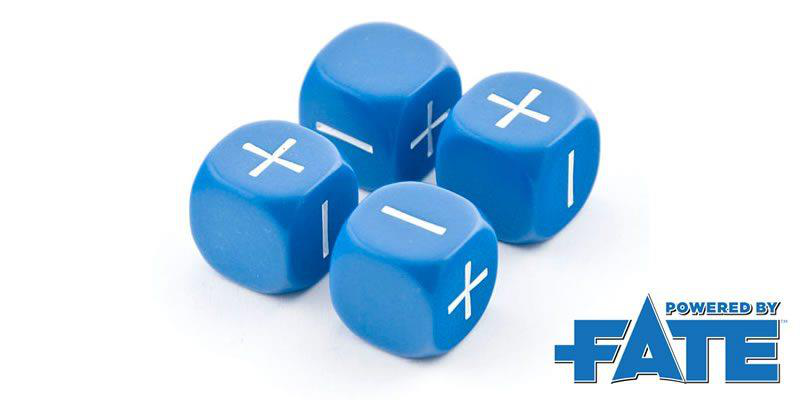
Let’s unfold the scene layer by layer. First and foremost, the GM created a scene for the players to play in, which we refer to as a "setting. "The GM described the air, time, and location, each of which has its own characteristics that will affect the players as they act. In FATE, we call these characteristics "aspects." As players arrive on the scene, the GM starts to describe the scene and aspects that will affect players' behaviors according to their own perspectives. When the GM began to describe the odor, Player 2 experienced a negative outcome. Player 2 has the aspect of being a newbie detective; this is one of his first crime scenes, and he has a "trouble" with horrendous smells. These specifications of the Player 2’s character are designed by the player itself, with both his troubles and his aspects affected by the scene. Therefore, Player 2 has to take an action according to these variables. When Player 2 smells the horrendous odor, the trouble in his character is triggered, and without a miracle (which could happen), he will have a horrendous outcome. in this scene. In order to determine the outcome, FATE has a very clever design that it calls FATE dice (the dice are shown in Picture 1wn in Picture 1). The outcome of the dice roll will determine the scene, as well as any problems or other variables that may arise. Dices outcome will determine the scene alongside with troubles and other variables that could affect the scene. The outcome will be calculated like this; Dice rolled; -1 Trouble gave; -2 Aspect gave; -1 Result; - 4, which means the scene will cause a mental or physical damage to the character in a dramatic way.
GM continued to describe Player 2's actions after the outcome was determined. The negative outcome can be prevented later in the game with medicine or a nose clip, but it depends on Player 2’s decisions or whether the GM is generous enough to spare the player a solution option. The GM of the game, like a SCRUM Master in a SCRUM team, could help the players with new options in accordance with the FATE set rules. In this case, the player can use what we refer to as Success at a significant cost. The player can choose to break his nose in order to stand against the odor coming from the body. This is a great sacrifice that will affect him throughout the whole game since it’s a major injury. However, he will get rid of this trouble that will affect him throughout the whole game. If we try to compare these occasions in a SCRUM team, when a team member struggles to solve a bug in time, he has to stay awake so long that he sacrifices his crucial time with his daughter. He will get rid of the bug he has caused and win a hundred-thousand- dollar project from the client, but he will still be hated by his daughter for a long time.
FATE and other RPG systems help to create a simulation that will help players understand and learn from their mistakes, how to earn a great win, etc. Still, as with other systems and SCRUM, it was dependent on the human factor—how players and the GM used the tools provided. In SCRUM, these instruments are called artifacts, and FATE, like other RPG systems, has its own artifacts too. While these artifacts differ depending on the system and their playability is dependent on the player's abilities, they are all based on the same principle: making a fun game. A SCRUM team aims to create a working product, whether all planned features work or just an MVP, just like the enjoyable game created by the FATE players. RPG games are products that help people have fun, learn lifelong lessons, earn friendships, and sometimes, just like in SCRUM teams, break people’s hearts. All these depend on the human factor. Still, if you know how to utilize the given artifacts, the team will have the best possible outcome, which could be presented by the game or the product.
Benefits of Learning FATE in SCRUM
Enhancing teamwork
Each FATE game is played by a group of people led by a GM. In order to have a decently fun game, the team needs to be adequately in line with the structure presented by the GM. This adequacy needs to be followed by decent harmony between the teammates. Both FATE and SCRUM require a team that harmonizes in a spectacular way in order to have an increment. SCRUM’s increment is a product that will achieve the purpose determined by the SCRUM team. On the other side, FATE’s increment will be a novel that is directed by the GM and players. The final increment of the FATE game will be a great novel for its reader that can signify great teamwork and a series of achievements by players. Their teamwork will enhance the communication within the team, and it will be reflected in SCRUM as well. The team’s harmony in SCRUM would result in a successful increment that could fulfill the purpose intended by the product owner.
Any RPG could achieve a similar result to what was discussed in the previous paragraph, but FATE excels among them with its dynamics. First of all, FATE’s system rewards teamwork with a mechanic called teamwork. Mechanic works in three different ways; adding skill points to character by inspiring or assisting them, invoking free aspect1 or taking their teammates turn. This mechanic is mimicking what could happen in real life or on a SCRUM team. Think of a situation where a customer is getting out of hand in a retrospective meeting that includes a SCRUM team. The product owner (PO) cannot handle a series of questions coming from stakeholders. In this situation, the SCRUM Master could take the PO’s turn to speak and take initiative to calm the situation. In fact, other team members, such as developers, could use this advantage to make their own point. With this mechanic of FATE, your players can simulate a real-life event like this one and learn from their situation.
FATE creates a great exercise area for the team, where they can exercise real-life events, enhance their teamwork, and apply it to their SCRUM skills.
Creating user stories and refinement of tasks
Creating a user story is not an easy task. Understanding the aspect behind the user's purpose may be difficult for team members to grasp. FATE has a mechanic called aspect, which was previously mentioned. Aspect is the cornerstone of all mechanics in FATE. Every layer of a scene has its own aspect, and just like in real life, these aspects could have an effect on the players. Continuing from the last example in footnote 1,
The air is thick and dark. The footsteps of Player 1 are echoed by stone walls. It shivers at the flames of torches. Player 2 and 3 are blindly screaming, their voices just fluttering in the air, hopelessly asking for help...
First of all, the air being dark and thick gives an aspect to the scene that could be scary and claustrophobic for players that could be affected. The stone walls could give an advantage to Player 1 with their resounding effect. The blaze of the torches could be the only source of light that can be used to enlighten the area if one of the players has a magic skill or something that can be throwable and flammable. All these aspects can be used by players to create an action, like a user story. as an example; Player 1 wants to create a fireball from the blaze of the torch by using his fireball stunt2. This story line is populated by the capabilities of the aspects that are present in the room, just like in a user story presented for a product.
Furthermore, FATE’s aspect system can help refine tasks in SCRUM. In SCRUM, we have a task hierarchy starting from epic-user-stories-task. By refining an epic, the member will have a user story and then a task. To create a user story, the member will need other inputs, such as the purpose of the action, existing abilities in the product, etc. Nonetheless, the user story will be refined from an epic that covers multiple functions. Just like an aspect of a scene, FATE gives general functionality by naming an aspect to an object. If the room is bright, the user may require the assistance of sunglasses, in which case the player must locate a pair of sunglasses.
FATE’s mindset created by aspect and stunt mechanics is easy to grasp when you understand the intention behind it: giving something a purpose. Each layer of the game will have its own purpose in leading the game to what its creators intended, just as a SCRUM team does when creating their product. FATE provides an excellent perspective from the standpoint of SCRUM: a hierarchy that can aid in the development of a user story and the refinement of tasks by aspect and stunt mechanics.
A great training room for scrum teams
A role-playing game could be a great way to simulate real-life events. FATE, in particular, provides an incredible opportunity to improve the team's mechanics skills. Previously, teamwork and success at major cost mechanics have been mentioned and their effectiveness discussed. Furthermore, there are far more effective mechanics set in the FATE system.
Success with Style: If a roll result and skill points plus other aspect effects combine to produce a +4 result, the success of the action can become an artistic performance by the player. As an example, while he flies at a tremendous speed, he feels like time and space are broken in the cockpit. He never felt a power like this one. It was a spectacular moment when I shot the opponent with a machine gun. Despite the fact that the opponent was a fourth generation fighter, his immense skills defeated the superior opponent.
Overcome: If a player encounters an obstacle, the dice roll + skill point + other aspect effect result will always result in a result that overcomes the obstacle. Still, a player could have a major cost or a great boost, again in accordance with the result mentioned before. For example, while the player is chasing the thief in a dark alley, a huge chunk of boulders and stones falls from an ongoing construction site. A clumsy worker slipped a huge card while he was watching the chase, and the player is now blocked. He knew this was his last chance to catch the thief. He runs towards the boulders and jumps like he has never done before, but still, it was a little short, and while he was landing, he crumbles over his hand. The player will have an elbow injury until the end of the game... As seen in the example, the player has overcome the obstacle, but as a result of the action, he will have an injury, which will affect his game.
Create an advantage. The player can create an advantage by invoking an existing aspect in the scene or by introducing a new aspect based on their skills. For example, Player 1 is a great judge of character. A lie will never fly, and she can catch it from the person’s eye. Even though Garfield is a decent liar, Player 1 knows a way to reveal his secrets... In here, player 1 starts to invoke an aspect depending on his rapport skill3. Like in real life, creating an advantage will give you a higher position compared to your opponent. Therefore, Player 1 will gain +1 or more in accordance with his proficiency skill. This advantage will help him win the battle or overcome the situation. Still, his luck could be against him, and the outcome of his dice would be disastrous. Even then, he can make a sacrifice by using Success at a high-cost mechanic while continuing the story.
Each mechanic of the FATE system is intended to encourage the players and give them a chance to continue the story. The player can create a series of mechanics that ensure he gets the opportunity or result he desires no matter what, whether with a great sacrifice or a great reward. Just like in SCRUM, FATE supports continuous incrementation. With every session of the game ending, the story moves forward with new abilities, events, aspects, etc. just like a product after a sprint has concluded.
Conclusion
Gamification is now widely used to enhance and improve the performance of teams on a product or to support their learning progress. In this case, the paper explained how to enhance adaptation of the SCRUM by the teams if they play FATE RPG. If teams successfully adapt the SCRUM framework by practicing it with FATE RPG, they will understand the importance of gamification and enjoy life even in the work environment. Teams can gather in a zoom call or face-to-face (preferred) during leisure or happy hours to play a 1-2 hour session of the game to continue iterating. As the game progressed, players improved their game skills, and the GM and Scrum Master's observations of the team improved as they became more familiar with their personalities. Like learning any new ability or program, it will take time to make a decent iteration of these sessions, but teamwork and the team's commitment to SCRUM will increase gradually.
Notes
1 Invoking an aspect; When a player is inspired or triggered by an event, the player can invoke a new aspect in accordance with its background story/other aspects. For example; Player 1’s relentless rival enters the area. The air thickens, a darkness blurs the vision. He can’t see anything besides black shades playing with his mind. Player 1 remembers the time when he was listening footsteps of his father when he was a child. When the last time he heard that steps, his father never come back. He just closes his eyes and tries to listen the voices carefully… In this example, Player 1 had a background story that triggered by an event. He invoked an aspect that he can enhance his hearing ability thanks to his background. That is what FATE calls invoking an aspect.
2 Stunt; These are spells or abilities that are created by the players in accordance with their aspects.
3 Skills are characteristics specs of the player. They are degreed and scored according to what called as pyramid scheme. For more information, please look at fate condensed, please click here .